I have been writing this round-up for what seems like forever, mainly because I have just never sat down and finished adding all the links! So I added a few more and think that settles it for this week.
What is ISIS a product of? Ziad Majed breaks down the root causes behind the rise of this extreme group.
“The news is for idiots” was a comment I saw on someone posting their opinion on a certain situation. This view however is shared by many. It is better to avoid reading it and pretend not to have an opinion on any matter. I decided to briefly analyse my Facebook feed, and describe feelings and actions of those who are ’non-political' (self-proclaimed) on specific events this summer, and on other relevant issues. Here are the results:
Syria: indifference
ISIS: “we in the civilised world” or indifference
Gaza: indifference or simplified as “Give peace a chance!”
Russia/Ukraine: indifference or “always knew they were corrupt bad guys, Bond told me!”
Ebola: indifference
Brazil: indifference, except of course when it came to the score of the world cup matches
Olympics/World Cup news: as long as those stadiums don’t delay the opening ceremonies, I’m indifferent
Ferguson: Some are outraged, some are completely indifferent
Tim Horton’s being bought out by Burger King: mild outrage
Gay rights: If there’s a party, I’m there!
Canadian government making atrocious decisions: mild uproar
Rob Ford smokes crack: outrage
Airline crashes: mild indifference or trip cancellations or boycotting the airline
Celebrity death (A to C list): devastation
Parking ticket: outrage
Aboriginals: "I guess it’s important, but I really don’t know anything"
A TV show gets cancelled: sadness, calls for a Kickstarter to be created begin
Reduction of cycling lanes: outrage
Someone smoking on a non-smoking patio: more outrage than drunk driving
The weather: depends on if it’s good or bad
Ben Affleck as Batman: petitions signed
Justin Bieber’s behaviour: petitions signed
Cell-phone provider policies: blind rage
Ice bucket challenge: “yay looks fun, and I’m doing good!” “What’s ALS?” “Why are people wasting water?” And of course, moral superiority that we waste water in other ways, why is this any different?
Jennifer Lawrence nude photos leak: moral superiority
Why contemporary art is exclusionary.A very interesting discussion on how contemporary art is becoming more exclusionary. I would also argue that it is becoming commercialised in a very different way: it's becoming a larger interest in the mainstream (Marina/Jay-Z as one)
Rebel Architecture.A new six-part series coming soon to Al-Jazeera (link leads to trailer and some information on the series). Lots of interest recently around "activist architecture", "architecture without architects", and being "against" a certain form of architecture.
June and July saw Rhye, Todd Terje, Maurice Fulton, and Blood Orange on loop but on the playlist these days is leaning towards some great throwbacks:
"8 Ball" by Underworld
"Is it good to you" by Heavy D & the Boyz
"I'm not feeling you" by Yvette Michelle (remember Funkmaster Flex's "The Mix Tape Volume II 60 Minutes of Funk"?)
"Rock the Discotheque" by Justin Winks vs. Casio Social Club
"New York" by Kerrier District
"Strawberry Bubblegum" by Justin Timberlake
"Clairevoyage" by Mungolian Jet Set's 16th Rebels Of Mung (Ft. Lindstrom & Dominique Leone) - absolutely adore this one since I heard it on Skatebard's mix for Sid Loves Turbo back in 2007. Can't find a YouTube video or sound cloud, but I've embedded Skatebard's mix for Sid Loves Turbo. The song starts at 07:30 (the whole podcast is worth a listen)
"Bad Girls" by Donna Summer (I blame watching Arrested Development...this played twice and just got stuck in my head!)
Cities and ambition - quite dated but an interesting read. Would be particularly interesting to read something that isn't so centred around North American and European cities though
Fashion Logos - some history of five of Another Mag's favourite fashion logos
At times like these, the words of Sa’dallah Wannous are very relevant.
"My life has neared its end and I still dream of saying “No.” I wanted, and I want to say “No” to the “Yes” citizen, to the prison-homeland, to the modernization of the methods of torture and domestication, to the official discourse, to the visas for Arab countries, to the fragmentation and the division, to the referenda of the 99.99 percent, to the balloon celebrations, to the war that strengthen the police, to the victories which offer the leadership of the Arabs to the oil princes, that increase the gains of the businessmen, and lead to the agreements of Camp David…
I wanted and I want to say “No.” And I search for my tongue but find only a foam of blood and fear.
From my severed tongue the defeat started, and the funeral procession set out … From my suppressed “No” the enemy got through, as well as the separation, the poverty, the hunger, the prison, the torturer, and the contemporary Arab collapse…
Briefly, if it weren’t for my suppressed “No,” half of me wouldn’t be in the coffin and the other half dragging itself behind it. And my deprivation from my “No” made me not only into the victim and the spectator, the dead and the mourner, but also into a conspirator…
…[T]he “No” citizen is, for the Arab thrones, a bigger danger than the Israeli danger, and a conspiracy worse than the imperialist conspiracies…
…And until I recuperate my suppressed “No,” the funeral procession will continue, with us dragging our tails behind it."
Sa'dallah Wannous, "Ana al-Janaza wa al-Mushayyi'un" (I am the Deceased and the Mourner), in Al A'mal al-Kamila, 3, pp. 440-42, as quoted in Elizabeth Kassab's Contemporary Arab Thought, pp. 56-57) [via kalimatmagazine]
Times like these also remind me of Mona Hatoum's work 'So Much I Want to Say' (1983).
"The video So Much I Want to Sayconsists of a series of still images, changing every eight seconds, which show the artist's face in close-up with a pair of male hands gagging her mouth and preventing her from speaking. Meanwhile her voice on the sound-track repeats over and over the words of the title. This is one of Hatoum's earliest video works and is based on material from a liveperformance. During a tour of Canada in 1983 she participated in a slowscan video exchange between Vienna and Vancouver entitledWiencouver IV. Slowscan satellite transmits an image every eight seconds, with continuous sound via telephone lines. Hatoum's contribution, transmitted live from Vancouver, was also titled So Much I Want to Say. The video work uses footage from the live transmission. It was made at the Western Front Art Centre and is a Western Front Production.
[...]
In So Much I Want to Say the male hands, which gag Hatoum's mouth, form a physical and visual barrier between the artist and her audience, which seems on one level to prevent her from being seen, heard or understood. They provide a symbol for a cultural elite which stifles the voice of society's dispossessed, those who are alienated through their race, nationality and gender. By presenting images where she appears to be silenced, Hatoum exposes the predicament of political minorities who are silenced or ignored. Her ineffectual struggle to pluck the hands from her face contrasts with the persistent repetition of her voice on the sound-track, demonstrating that it is through her artwork that she has found a channel for her political ideas."
I've had up and down relationships with blog hosting services. When I first started blogging in 2007, I used blogger, but then I moved the blog to Wordpress because you couldn't have pages on Blogger at the time. Then I started another blog on Blogger, and a year later, 'microblogged' on Tumblr. I updated my Blogger more often, then I stopped updating both, and then I closed down my Blogger and started updating my Tumblr instead. A few weeks ago, I realised that Tumblr is the last place for long text pieces and contemplated reverting back to Blogger (if transferring posts was easy). I finally decided to call it quits when I stumbled on this post from 2011, which has many things I agree with. Tumblr was a space that glorified the most mundane of posts, and it wasn't engaging in any form of dialogue (the fact that you have to install third party comments is proof enough), which is just irritating.
My Tumblr is still there (I've been meaning to write a post redirect people to this blog but have not gotten around to it), which is good since a) I have not finished reposting all my posts from Tumblr, and b) it seems a lot of my audio posts aren't transferring into Blogger so easily. It's funny... it seems that, no matter how much I try, I always come back to Blogger. I think the reason for that is simplicity. Nowadays Blogger has a pages function, and even though the templates aren't aesthetically pleasing (what's up with the ugly drop shadow behind photos you have to remove from the HTML code?), I'm willing to forego that for comfort.
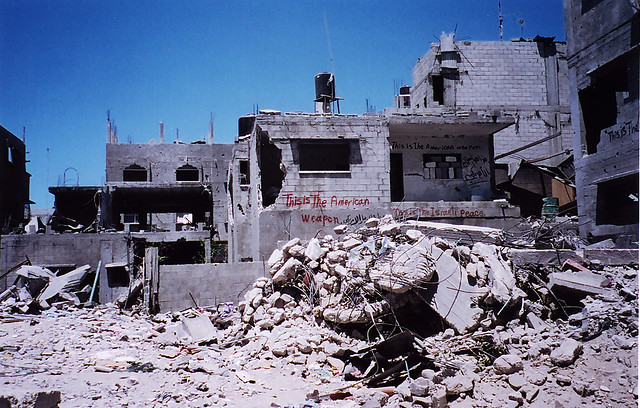
I took this picture in Gaza in August 2002. That was my first and only visit. The rubble is a former apartment building, which was destroyed by Israel via air because they suspected a Hamas member was hiding there. None of the occupants were evacuated from the building before it was destroyed. Gaza is an open air prison, and as I type this, its citizens are under constant air strikes from Israel.
What’s most frustrating is that media coverage and responses from world leaders (mostly West) continue to be one sided: always putting Israel first and Palestine second. The word “disproportionate” in regards to many things is completely non-existent.
As a designer, I felt annoyed while reading this article. Despite agreeing with a lot of the author’s points, I also felt that it would’ve given it something more if she had bothered interviewing designers who work for these publishers. The fact is designers rarely have a final say when it comes to marketing. This neglect of a designer’s opinion makes us designers yet again seem irrelevant in the process.
The blame cannot just be put on marketing when it comes to stereotypical covers however - authors and translators likely play a role in constructing the brief. As a designer, I can’t tell you how many clients (both Arab and non-Arabs, both educated about the region and those merely interested in it) have asked me for “Arabian looks” that are nothing more but silly stereotypes. Yes people do judge books based on their cover: the proof that good design works is everywhere. When I browse a bookshop and come across books in translation, I often shake my head in disapproval. Frankly, I question a publisher who has the nerve to favour marketing over content.
I’m not saying designers are innocent either: the fact that the design profession is so reliant on the client allows this to happen. Rarely do designers question this unquestioned service to clients (it is their paycheque after all), or argue against the contents of a brief. But this is also the problem with universal/standard design. I’m certain when designers think of the Arab region the first imagery available to them is arabesque, veils, mosques, camels, turbans, and geometry. Context is everything - there is no one size fits all solution.
I believe that publishers need to start thinking about having teams of designers designated to work on specific regions - designers that are aware of the places they are designing about. Or better yet, publishers should hire an experienced and knowledgeable freelancer familiar with a specific region and who is capable of giving them an informed critique. Either way, designing book covers is like translation: the wrong choice can alter the meaning completely.
Finally got around to updating my flickr after four years! I’ve been travelling a fair bit lately taking pictures and I realised it’s just great for archiving. Will likely be adding some more in the next bit.
The Gherkin sure has made an impact in its relatively short life: doppelgängers in all sizes in Barcelona, Beirut, and Doha…although Jean Nouvel designed both the one in Barcelona and in Doha. Recycling much?
On my second visit to the Catalan capital, where I was attending the FAD conference, I was able to discover a lot of it on foot. I enjoyed being able to cover most of Barcelona in this manner, something almost unheard of in London. I was impressed by many things, but I was disappointed by a whole lot more. What I often thought about was who this city did not belong to, and of course this made me think of Lefebvre’s concept of the right to the city. As Harvey (2008) states, “We live, after all, in a world in which the rights of private property and the profit rate trump all other notions of rights.”[via]
Since my research deals with this concept of locality, I thought about the absent local life in Barcelona. The city itself, as the documentary I stumbled on discussed (above), is nothing more than a theme park, a European Cancun of sorts, made entirely for the enjoyment of tourists - tourists who live as though they’ve never left home (I witnessed an American tourist buying American scratch cards at a shop and was shocked). The entertainers on La Rambla seem out of place, as if they are stopping over before completing their journey to Las Vegas. The hamburgers and frankfurters that flood the menus are also out of place. I’ll be the first to admit that I personally have never enjoyed food anywhere in Spain (in all five of my visits to different regions), but there are so many alternative cuisines around the city from all over the world it’s easy to find something affordable and good.
I wondered then, what was the appeal of such a place? Why are people flocking to come here? It’s overcrowded wherever you go, and most of the tourists (as the documentary differentiates between three types of visitors: tourists, travellers, and voyagers) have no idea what Barcelona or Catalonia is about.
On the plane over to Barcelona, I had written a whole piece on travel guides and how they only cater to the super-rich, or the typical tourist routes. After watching this documentary however, I felt that sharing this film was much more relevant and important since these are issues we are witnessing in cities worldwide.
Notebook accumulation since beginning my MA in 2011. Actually this is not that accurate (many are missing!). Let’s call this the notebook accumulation since I moved to London in September 2012.