Decolonising the Institution, a roundtable discussion

On Monday 15 January at the Royal College of Art, I will be part of a roundtable discussion on Decolonising the Institution alongside Tanveer Ahmed, Hannah Catherine Jones, and Lola Olufemi, chaired by Rathna Ramanathan. 

The roundtable will discuss decolonisation at the RCA whilst looking to institutions such as SOAS and Cambridge University who are leading the charge to fundamentally challenge the White Male Western dominance of education within the UK. 

The event is hosted by the Royal College of Art Students' Union and is open to the public.

Details:

  • Monday 15 January 19.00-20.30
  • Gorvy Lecture Theatre, Dyson Building, 1 Hester Road, SW11 4AN (map) 
  • Facebook Event

International Design Organisations: Histories, Legacies, Values


I am happy to announce that I will be taking part in a plenary discussion alongside Jonathan Woodham and Nina Serulus at the International Design Organisations: Histories, Legacies, Values conference at the University of Brighton.

The conference will feature some wonderful panels examining the roles of international design organisations in a post-industrial and post-organisational world. Download the programme here. 

From the Drake, to the Broadview, to Filmores


Eventually, I want to write more about this but this short post will have to suffice for now. Toronto's next gentrification culprit: Filmores. This year, the Broadview Hotel (formerly Jilly's) opened. The Broadview Hotel attempts to recreate the change the Drake Hotel created in the west end, by literally copy pasting the model. Mark my words, this gem (Filmores), located at Dundas and George (oh so close to the memorable corner of Dundas and Sherbourne), is not far behind. 

Here's how it appears gentrification works in Toronto: neighbourhoods go through gentrification, but Coffee Time (which I am convinced is a front for money laundering), stays in place. Super-gentrification begins when Coffee Time gets replaced by a medium range restaurant, and hyper-gentrification happens when the medium range restaurant becomes a boutique/concept store, coffee shop or restaurant. For evidence of my theory, look no further to King St. West and Bathurst, where Coffee Time was replaced by Wild Wing, which will soon be replaced by something with 'raw' walls and a chalkboard. Also, the corner of Queen West and Niagara, Coffee Time has been replaced by 'Loaded Pierogi'. So it begins...again.

Studio X Amman at Milan Design Week

Happy to announce that I will be speaking at Studio X Amman's event at Milan Design Week (Salone del Mobile) on Saturday 8 April at the Palazzo Clerici.

The event begins at 11:30am, and I will be giving a talk titled 'Propositions for design culture in the Arab world' during the 'Days, Weeks, Biennials: Design in Unsettled Times' session from 14:30-16:30 alongside Karim Kattan, Mohamed Elshahed, Deniz Ova and Rana Beiruti.

Trying a new medium...medium

Joining new social networks is tedious, however, I like the engagement this site provides – particularly that people can comment on particular passages. It's also clean and easy to publish on, providing the author easy access to headings and text size, quotations, and uploading images. I decided to give it a try and published a piece on the branding of Kuwait Airways: medium.com/@danah.abd

Sundays with my PhD

Sunday mornings in the studio, analysing what feels like a never ending amount of data! The process here consists of several steps. After collecting this data during the charrettes I conducted in September in Amman, I took the last set of images of them while they were on the wall. Then I took the original files and marked them by group number, question numbers, and dates. The first set of images (taken after the 2nd activity in the workshop was completed) were transcribed (verbatim) as a visual map (using Scapple). The images were cross checked to ensure nothing fell out when I transported the original files. This step consists of a lot of trying to figure out some handwriting!


Analysing Activities one and two from the Charrettes


The second step was to transcribe the results from the final activity in the charrette. This entailed working from the original file and the images as well as the original visual map in Scapple. From there, I duplicate the file, and cluster the ideas based on how the participants clustered them. These are then cross-checked with the images.

Analysing the final activity in the workshops. Original file on the table, Scapple file on the screen.

The third step in the analysis was to compare the questions. As each charrette consisted of two groups, I compared results from each group to each other by creating a separate Scapple file (using the final data only) and compared them by adding arrows to similar elements and then writing a summary of the discussion. This is done for each question.

Scapple File of the Question Comparison across groups
Finally, the last step using visual maps is to compare the data from each group for each question across the two charrettes. This is then followed by at least 10 more steps (and a return to NVivo) to complete the analysis!

Workshops: Amman Design Week + PhD


In September, I will be heading to Amman to conduct a workshop for the first ever Amman Design Week. The workshop is called 'Designers Represent! Developing a Design Association in Jordan', and will take place on Sunday 4 September. The idea for this workshop was from one of the findings in the interviews and focus groups I conducted back in December 2015 and March 2016 for my PhD fieldwork. More information and registration can be found here.

After a series of interviews and focus groups, my trip will also see me conducting the final phase of my PhD fieldwork: the charrette. Bringing together designers, design educators and design students from across Amman in the same room, the charrette seeks to reimagine what design education curricula could be. If you're a designer, a design student or design educator based in Jordan and are interested in taking part, please feel free to send me an email. For more information on my PhD work, you can check out this video. 


words I'm growing tired of hearing

In different – if not all – contexts...
  • Archiving
  • Mapping
  • Mindfulness
  • Innovation 
  • Start-up
  • Entrepreneur
  • Appropriation
  • Happiness
  • Changemaker
  • Busy
There's probably many more.

Umberto Eco on personalising books


In his recently translated How to Write a Thesis, Umberto Eco – who passed away this past February – wrote this about personalising books. I've always been a serial underliner – but I've yet to follow his advice on colours. This book is an invaluable resource and I highly recommend it. Even though some say it is dated as Eco discusses his method of using index cards for references, the task is to incorporate these methods into the ways we deal with citations in 2016. While I use a number of software for saving my arguments, quotations, and notes on things I've read (Evernote, PapersApp and formerly Zotero and Mendeley), sometimes the infinite amount of tools at my disposal means that I've lost a lot of information because I can no longer find it. Perhaps a box with index cards sorted alphabetically isn't a bad idea...but I'm still trying to incorporate this digitally.

Towards a Locally-Centric Design Education Curricula

Last month, I presented my ongoing PhD research at the Lab at Darat Al Funun in Amman. Over 35 designers and non-designers turned out to the event and asked some great questions. Many thanks to the Amman Design Week team who helped promote and organise the event and who tweeted about it (#DEJ16), as well as to the people at Darat Al Funun for providing me with the space. Watch the entire talk below.

Transform

A view of Amman and the Roman theatre from the citadel

The last time I was in Amman, I landed on the 11th of February 2011. After spending 12 hours in the air without internet or phone coverage, I turned on my BlackBerry Torch and received a text message from a friend. The text said 'congratulations, he stepped down.' I smiled...Mubarak finally did it. That night, I drove around Amman with my uncle and my cousin looking for knafeh to celebrate, but the entire city had the same idea, and they ran out of knafeh.

Winters in Amman were very different from the summers. Summers were characterised by heavy traffic from Jordanians living abroad visiting family and Khaleejis spending their summer holidays in the city due to its relative stability. The roads in winter were quiet. For anyone visiting, it felt as though it was you and the locals only.

Five years later, I land in a new airport with an expired Jordanian passport. I glance over at the visa queue and notice that the visa for foreigners had doubled since my last visit (40JD). I try my luck with the officer and he lets me on the expired passport but reminds me to renew it. The new airport is nice and quiet. Rather than Arial Arabic that floods most Arab cities (let's call it the official typeface of the Arab region), nice type in both Arabic and English grace the signs.
Roof of Queen Alia International Airport

In Amman, the car is king. The streets are confusing and I'm not sure how people know where they are going here, but they do. As I drive through the streets – always as a passenger – I notice the new shiny towers that dot the skyline. Last time, the 'new downtown' – Abdali – was merely scaffolding plastered with images of happy people, shopping malls, and new ‘possibilities.’ Today, this new ‘possibility’ has been revealed, and it's tall towers, hotels, shops, the boulevard, and other buildings that aim to attract businesses able to afford the price tag. Abdali is the latest GCC inspired and funded construction project roaring through Arab cities. Five years ago, the under-construction Jordan Gate Towers towered over the skyline. In 2016, a few more floors have been built, but they remain unfinished and already look dated.
Le Royal hotel and the Zara Towers on a gloomy day

The events of the past five years have taken a huge toll on the city and the country as whole, with Arabs from all over the region seeking refuge in it. It remains incredibly expensive with a high currency, low salaries, and the mysterious 16 per cent tax. This has also turned traffic into a 24/7 ordeal. The amount of cars has increased, yet the roads have not been expanded. Whatever, when there’s only two lanes, Jordanians turn this into four to ‘maximise’ space! Taxis have gotten worse – they don't take you where you want to go but where they want to go. Luckily for me, Uber – while I do not agree with many of their practices and I was reluctant to use them – saved me from being stranded somewhere in Jabal Weibdeh. Public transportation remains bad as always, and the sign of hope from 2010 – the rapid bus transit lanes that were being built – now sit empty. “Why is public transportation so bad in this country?” I asked. “Because why would we want Jordanians to connect to each other easily?" a friend replied sarcastically. Unfortunately, Amman is huge, its sidewalks are not great and contain a number of obstacles, and it's all hills, therefore walking is not an option.
The view from Darat Al-Funun in Jabal Weibdeh
Amman’s challenge is that it is a city reduced to stereotypes and clichĂ©s. It is often described by these stereotypes and clichĂ©s by people who have never even stepped foot in it. When I was younger, I disliked it. It was boring and austere. That was Amman in the late 1990s – full of Lada's, incredibly tall sidewalks, coffee shops, 3amo's in green suits and oversized leather jackets, houses that were freezing in the winter, women wearing brown lip liner, and boys sporting way too much hair gel. Ten years went by before my next visit. This time, I made friends, and thought, while there still isn't as much to do, it's easy to make friends here, and that makes it tolerable and fun. I didn't love it, but I didn't dislike it either.

Amman is an Arab city: the streets are tight, the traffic is ridiculous, the car dominates because public transit is rubbish, Hyundai's and Kia's flood the streets, people walk on the street rather than the sidewalks, everything is infuriating, the food is great, people are nosey, water runs out, signage is either in Arabic or bilingual and the English is often misspelled, the law exists but isn't implemented, things are broken and hazardous, people cross the street as if they have a death wish, street names are decorative, google maps is not accurate...the list goes on. But the city has a certain charm in the spring. The rain has made the hills green and cleaned the city.

On this more recent trip, I was driving around, the sun shining beautifully through the window, a black plastic bag flying in the sky (let's call it the official bird of the Arab world), and I imagined, for a slight second, that I'd spot the beach. Then I realised where I was and that I was probably hallucinating from being in the car for so long, but it hit me: water was Amman's missing ingredient.

Accumulation

Three years in London, three years since I began my PhD. Time flies. Since then, I've finished over 20 notebooks/agendas cover to cover...


31 minutes on Bond Street

11.58 – I get off the Central Line at Bond Street. I almost suffocated on the train. Everyone's smelling like a Fish & Chips shop these days. There came a certain point in time in 2012, when I first moved to London, where the carriage was empty (only once or twice really). Until the Crossrail opens, this is going to get worse.

11.59 – Walking towards the exit I notice the exit sign is written in almost every European language. I'm surprised – judging by our proximity to Edgware Road and Selfridge's – that Arabic is not on the sign.

12.01 – I'm starving so I pass by the only editable quick place to eat nearby, PrĂŞt, but it's packed and everything has ham in it.

12.05 – I'm walking in the direction of high end shops. This means I pass by TrĂ©sor Rare and avoid the sales lady yelling "excuse me hello" about three times. The Swiss-shop sells creams that make your skin for the affordable price of £900. I once got dragged in there by a pushy salesman, who went down to £150 (!!!) for an under-eye cream. I took the samples and told him I'd think about it. I'm nouveau pauvre (the student/creative with champagne taste on a beer budget that make impulse purchases), but not that nouveau pauvre.

12.07 – Someone with an umbrella that says 'European wealth' passes me. There are many rich tourists trekking through the rain. Many of them are tacky, nouveau riche types. I pass Fenwick. Of course rich Arabs are entering.

12.08 – Rich tourist with tacky Fendi luggage and umbrella almost takes me out by not paying attention. She didn't even notice it happened.

12.09 – I spot EAT. I got inside, pick a brie, basil and tomato sandwich and an Americano and sit down. I'm not sure why anyone with options chooses to eat here. I have little time, nor do It work nearby so I'm here. The others? Not sure.

12.12 – A woman asks to share my table. I have no problem with that. She's North American but our encounter is so brief I can't figure out where she's from. She's into her phone. She eat her meal, makes zero eye contact. English training.

12.29 – She gets up, wipes the bread crumbs off, says 'thank you' and walks into the anonymous city. 

A Manifesto of Change or Design Imperialism? A Look at the Purpose of the Social Design Practice

In June 2014, I had the opportunity to present my paper "A Manifesto of Change or Design Imperialism? A Look at the Purpose of the Social Design Practice" at the STS Italia conference 'A Matter of Design' in Milan, Italy. The proceedings were published a few months ago, and I'm happy to announce that my paper is available to read for free in the proceedings.

The proceedings can be found here: http://www.stsitalia.org/?p=1548&lang=en, and the paper is on pp. 245-260.

It's wonderful to see the journey the ideas within this paper have taken in the past three years. The idea started off through discussions with a colleague during our MA in Social Design at MICA, then evolved to a short presentation for the Goldsmiths Graduate Festival in May 2013, reworked for the STS Italia conference, and then reworked again for the proceedings. It's also making an altered appearance in Beirut next month as part of the Beirut Design Week International Conference (2-3 June 2015). I'm looking forward to presenting it in a non-academic oriented conference.

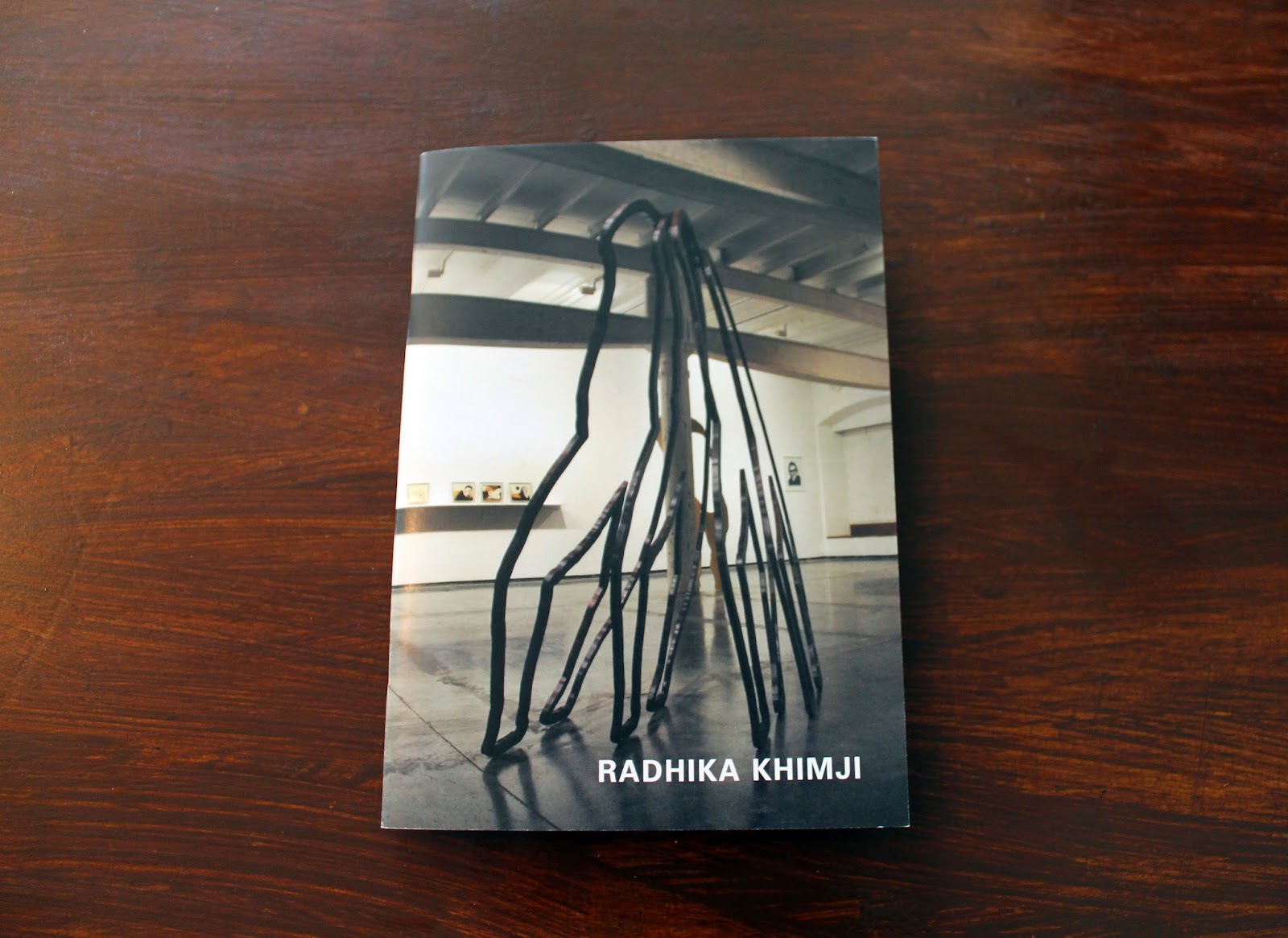
New design work: Radhika Khimji Artist Portfolio

Last year, I had the pleasure of working with London-based artist Radhika Khimji on a portfolio featuring her recent work. I finally got my hands on the printed copy of the portfolio, which I'm generally very happy with (a spine would make it more elegant). Radhika's work is striking and it stands out, which meant the design could not be intrusive – even though the movement of the pieces feel like a composition that would work very well in anything by Hercules & Love Affair. This was the first portfolio for an artist I've worked on, and although I am a big fan of her stuff, I found it much easier to connect with the work after having been able to sit down with the artist in her studio, surrounded by the work, and leafing through her images and note/sketch books. Below are some images from the portfolio.

Typeset: Baskerville and Univers | Size: A5


This generation's 9 1/2 weeks?

I'm supposed to be writing PhD related stuff but I'm going to take a break and write about pop culture instead. While I haven't read the book (nor have any desire to), don't plan on watching the film, nor read the Wikipedia entry, I must say that I believe Fifty Shades of Grey is 9 1/2 Weeks twenty-nine years later (minus the crazy box office numbers). I'm basing this entirely on tidbits I read from the media and the two minute trailer I had to sit through waiting for Inherent Vice at the Barbican.

Now, the film that made stars out of Mickey Rourke and Kim Basinger was apparently met quite negatively at the time, but it is often cited (style! sexy! grimy-ish NYC!) by the younger generations (well, mine at least). There is no questioning it - did you see Kim in it? I'm not going to get into a conversation about what happened to Mickey Rourke, but let's just call it bad decisions. Although 9 1/2 Weeks was not necessarily about BDSM, it was about a sadomasochistic relationship - dealing with ownership of a woman's body and the master/slave relationship which I assume is what Fifty Shades deals with.

Looking back at the trailer of 9 1/2 Weeks now, much of this stuff is likely to creep its way in 14A films as many directors are quick to throw in a sex and/or nudity scene just for the heck of it. As for cast comparisons, I understand there's a lot of factors that go into casting, and despite society's obsession with sex (more heightened than ever apparently), the lead actors are, well, boring and Disneyish. This is very similar to the current music 'superstars'. I am referring here to the likes of Ed Sheeran, who appears to be emulating a look from 'indie' bands from the 2004-2005 period (he reminds me of Billy Talent, Fall Out Boy, American Rejects, Simple Plan, etc.,) and whose 'bad ass' credibility comes in the shape of sleeve tattoos that likely have an image of My Little Pony and other 80s-90s nostalgia; and Sam Smith, who is apparently 22 years old but looks 35 at least, has zero facial expressions, and whose style reminds me of 1980s-90s George Michael minus the charisma.

Back to Fifty vs. 9 1/2: Dakota vs. Kim? Kim wasn't just beautiful, she had style, charm and a certain elegance.
Via

While Dakota may represent exactly the type of character described in the book I have not read, Kim's character wasn't meant to be some vixen either. From the trailer of Fifty Shades I saw, Dakota has none of that electricity Kim brought. In fact, it felt like she belonged in a romantic comedy from the mid to late noughties period alongside Mandy Moore. As for the lead male actor, he's too much of a "I have a job in the City" pretty boy. He has no look in his eyes that gives you a warning that there's something dangerous about him (like Mickey did). I think the celebrities of today are in fact just representations of today's society: boring and extremely PC (you know, in that I am going to stay neutral in person but have an opinion online ONLY kind of way).

Link round-up - 5 February 2015


First link round-up of 2015:

Passages on nostalgia and authenticity


Been doing what feels like endless amounts of reading lately. Came across some fantastic passages, but these two in particular feel more and more relevant to recent conversations I've had (or found myself in!) and posts I've been seeing on social media.


From Undoing Culture: Globalization, Postmodernism and Identity by Mike Featherstone


From Cosmopolitan Vision by Ulrich Beck.

Latest work: Posters for Department of Social Science

I have been working with the Department of Social Science at Goldsmiths these past few months on their upcoming journal. I've also done some design work for other projects within the department organised by the Centre for the Study of Invention and Social Process. Posters found in the elevators of Warmington Tower! I have two others coming up and will post pictures up once I catch them around the college.